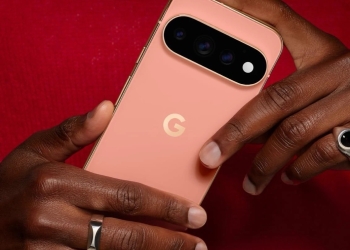


The Pixel 11 Pro’s flashlight is dimmer than the one on almost every recent flagship, and the reason appears to be sitting right next to it. HiLight, the rear notification ring Google added to the Pixel 11 series, is built from eight RGB LEDs arranged around the main camera flash, all sitting under a single frosted white diffuser. That diffuser also covers the primary flash LED, which means the flash no longer has a dedicated lens of its own to focus and throw its light forward.

Why the Pixel 11 Pro flashlight lost brightness
Notebookcheck laid out the mechanism after examining a set of comparison and microscope shots supplied by X user @multithreddy. Under magnification, the Pixel 9 Pro’s flashlight opening shows Fresnel lens elements and a textured pattern designed to stop hot spots. The Pixel 11 Pro’s opening shows a diffuser instead. Diffused light scatters rather than concentrates, and that is exactly what a torch does not want.
Independently, a teardown by Phone Repair Guru, relayed by Chinese outlet ITHome, confirmed the hardware: eight surface-mounted LEDs in a ring, each verified under a microscope to hold discrete red, green and blue dies, sitting behind one frosted cover. Nobody had to measure brightness to establish that part — the physical arrangement is visible.
Worth being clear about what this is and is not. This looks like a side effect of packaging a notification ring around an existing flash module in a phone that already gave up its infrared temperature sensor to make room, not a deliberate downgrade. But it is a downgrade all the same, and it lands on a function people use far more often than the one Google added.
What the comparisons actually show
Two separate tests point the same way. 9to5Google ran its own review units — Pixel 11 Pro, Pro XL and Pro Fold — against a Pixel 10 Pro XL, an iPhone 15 Pro and a Galaxy Z Fold 7, and put the Pixel 11 Pro XL last in the group — the same phone that ranks fifth worldwide at DXOMARK for stills and video, with the gap widening at distance. The @multithreddy test, run with all handsets at a fixed manual exposure and flashlight intensity set to maximum, compared the Pixel 11 Pro against a Galaxy Z TriFold, an iPhone 17e and a Pixel 9 Pro; the Pixel 11 Pro came out dimmest in both torch and camera flash.
9to5Google’s Ben Schoon summed up the trade-off bluntly:
“HiLight” on the Pixel 11 Pro doesn’t provide much utility, but making matters worse, it also worsens a common use case of every other phone’s rear LED – the ability to use it as a flashlight.
There is a partial consolation. 9to5Google found camera flash results between the Pixel 11 Pro XL and Pixel 10 Pro XL broadly comparable, with the newer phone’s output less harsh and warmer — a diffuser is genuinely useful when you are lighting a face two feet away. It is only the long-throw torch use that suffers.
What Pixel 11 Pro owners can do
Not much, and that is the honest answer. The diffuser is a physical part sitting in the light path, so software is unlikely to fully recover the lost throw. If you regularly rely on your phone’s torch outdoors or across a room, plan around a shorter useful range, or carry an actual flashlight. Notebookcheck reports that Google has not commented on the difference in flash and torch brightness, and as of 25 August no statement from the company on the subject has surfaced.
If you are still deciding on a Pixel 11 Pro, this is not a reason on its own to walk away — but it is a real, measurable regression against the Pixel 10 Pro, and it is worth weighing against whatever value you place on a colour notification ring you cannot see while the phone is face-up.
Sources: @multithreddy, via Notebookcheck; 9to5Google; Phone Repair Guru, via ITHome