

Samsung has published a detailed account of how it shaved the Galaxy Z Fold down from 253 grams to 201 grams in three generations, and the numbers involved go well beyond marketing language. Engineers reviewed roughly 270 components and more than 180 types of auxiliary parts, in some cases trimming as little as 0.001 grams per part to get there.
The starting point was the Galaxy Z Fold5 at 253 grams. The Z Fold6 brought that to 239 grams. With the Z Fold7, Samsung set itself a harder target: beat the weight of its own flagship bar phone, the 218-gram Galaxy S25 Ultra, with a foldable. It hit 215 grams. The Z Fold8 goes further still, landing at 201 grams — a total drop of 52 grams from the Fold5, and a thickness of 9.7mm, down from 17.1mm on the original Galaxy Fold in 2019.

Where the Weight Actually Came From
Samsung’s release breaks the reduction into three engineering efforts rather than crediting a single new material or part.
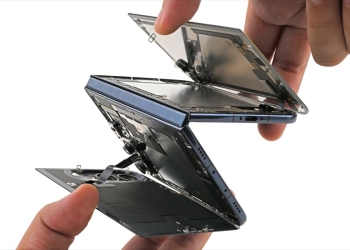
The first is what Samsung calls Flex Titanium — a titanium alloy film inside the Z Fold8 and Fold8 Ultra’s displays that’s described as “just tens of micrometers thick — roughly one-third the width of a human hair.” The metal plate that supports the display underneath it is machined to around 0.2mm, with the thinnest sections reaching 0.15mm, which Samsung says required reworking its machining sequence, tooling, and cooling process to avoid warping at that thickness.
The second is material substitution: Advanced Armor Aluminum for the exterior frame, and Clad Metal — a composite of different metals — on the interior rear panel, chosen for a mix of weight and heat performance. The Fold8 Ultra also gets roughly 7% more graphite in its heat-dissipation layer than the Fold7, despite the similar overall dimensions.
The third is the least glamorous and probably the most labor-intensive: a part-by-part audit. Samsung says engineers went through roughly 270 components and 180-plus types of auxiliary parts — brackets, tapes, fasteners, antennas — and eliminated about 15 of those part types outright, while trimming the remaining ones down to fractions of a gram. The circuit board was redesigned to remove unnecessary circuitry and shrink its footprint; the antenna was reshaped to cut overlap with nearby components.
“Creating a thinner and lighter foldable requires more than downsizing individual parts. It comes from greater precision in how materials are machined, how forces are managed and how structures are designed within a limited space.” — Samsung U.S. Newsroom
The Weight Savings Went Back Into the Battery
The most concrete example of what all this trimming bought Samsung is the Z Fold8 Ultra’s battery. It weighs the same 215 grams as last year’s Fold7, but the battery inside grew from 4,400mAh to 5,000mAh — an increase that on its own added about 6 grams. Samsung says it had to find that weight back through the same process: reworking materials, circuit layout, and component placement across the device, rather than any single fix.
Samsung frames the whole effort as a response to a 2024 YouGov survey it commissioned, which found bulk and weight were a top concern for people who weren’t considering a foldable, while battery life, durability, and display quality mattered most to people who were. Worth noting: this is Samsung’s own commissioned research, cited to justify Samsung’s own design choices, not an independent study.
Why This Matters Next to the Corner-Sinking Issue
This release lands about a week after Samsung had to explain why some Z Fold8 owners were seeing the inner display’s corners sink or flex under light pressure — a byproduct, Samsung said at the time, of the cushioning clearance built into a thinner support structure. Reading the two together, the 0.15mm support plates and tens-of-micrometer titanium film described here are the same components involved in that clearance. A lighter, thinner foldable and a completely rigid one are, to some degree, competing goals, and Samsung’s own numbers make clear how far it pushed toward the former.
Source: Samsung U.S. Newsroom