

Apple has entered the foldable phone market. The iPhone Duo, unveiled at the company’s September 9 event, starts at $1,999 in the US, ships with iOS 27.1, and lands in more than 70 countries including India, putting Apple’s first fold directly against Samsung’s Galaxy Z Fold line for the first time.
Pricing and Availability
The iPhone Duo comes in 256GB, 512GB, 1TB, and 2TB storage options, starting at $1,999 (US) for the base 256GB model, or $83.29 a month over 24 months through Apple’s own financing. Apple’s Upgrade leasing program, run through Klarna and limited to the US, starts at $57.99 a month for 24 months.
Pre-orders open Friday, October 16 at 5 a.m. PT, with the phone reaching stores on Friday, October 23. Apple named India among the more than 70 countries getting the phone in this first wave, alongside Australia, Brazil, Canada, France, Germany, Japan, and the UK. Another 28 countries follow on October 30. Apple has not published India-specific pricing yet.
Two matching accessories arrive alongside it: the iPhone Duo Case at $79, and the iPhone Duo Folio with Kickstand at $129, both orderable from October 16.
A Fold With Two Full-Size Displays
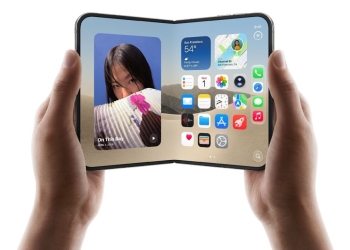
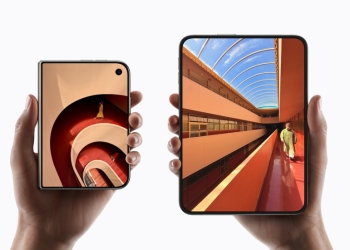
Closed, the iPhone Duo runs a 5.4-inch outer display that Apple says covers 90 percent of the screen area of the iPhone 18 Pro, making it usable one-handed while shut. Opened, the inner display measures 7.6 inches, which Apple describes as 50 percent larger than the iPhone 18 Pro Max screen. Both panels share the same aspect ratio, so content scales without cropping when the phone folds or unfolds.
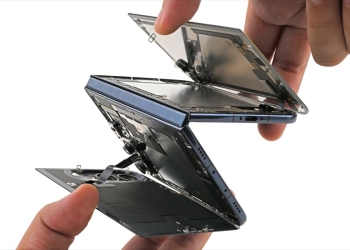
The body is grade 5 titanium with a mirror-polished finish, rated IP68 for dust and water resistance. Apple says the hinge is built from more than 100 components and holds the display flat when open, with a 3D-printed titanium hinge cover on the back. Ceramic Shield 2 on the front display is rated at three times the scratch resistance of the previous generation. Touch ID sits in the side button rather than Face ID, and a FaceTime camera is hidden beneath the inner display, staying invisible until it’s in use.

Specifications
- Displays: 5.4-inch outer, 7.6-inch inner Super Retina XDR, both with ProMotion, Always-On, and 3,000 nits peak outdoor brightness
- Chip: A20 Pro, built on Apple’s 2-nanometer process, with a custom vapor chamber and dual-battery architecture
- Cameras: 48MP Fusion Main with an optical-quality 2x telephoto, 48MP Fusion Ultra Wide, hidden under-display FaceTime camera
- Battery: up to 31 hours video on the inner display, 44 hours on the outer display, or 24 hours with mixed use, per Apple’s own testing
- Connectivity: eSIM-only worldwide, Wi-Fi 7, Bluetooth 6, mmWave 5G support in the US
- Software: iOS 27.1, with Split View letting two apps run side by side on iPhone for the first time
Apple built a version of iOS 27 specifically for the folded and unfolded states. Split View lets two apps sit side by side on the inner display, something Apple is calling a first for iPhone, and the Dynamic Island reflows to run vertically along the side of either screen. Later this year, Apple Pencil support with USB-C is coming to both displays, though the company hasn’t said which Pencil model or whether pressure sensitivity will work.
“iPhone Duo is the most transformational change to iPhone since the original. With an entirely new design and intuitive experiences, it shows what’s possible when hardware and software are engineered together and redefines what it means to use a foldable phone,” said John Ternus, Apple’s CEO.
Why This Matters for Android Buyers
Apple is arriving at foldables five years after Samsung shipped its first Z Fold, and its own release describes the form factor the same way Android OEMs have been pitching foldables for years: bigger canvas, real multitasking, a phone that becomes a small tablet. The Verge notes foldables made up just 1.6 percent of global smartphone sales in 2025, a market Apple is now betting will grow once its own name is attached to it. At $1,999, the iPhone Duo starts well above where most Android foldables land in their home markets, which could either validate premium foldable pricing industry-wide or push Samsung and others to sharpen theirs in response.
Source: Apple Newsroom