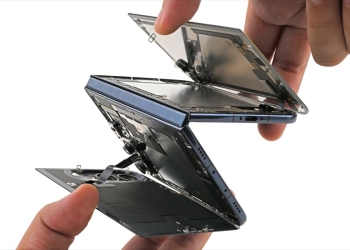


Samsung has spelled out how it is trying to keep the silicon-carbon battery in the Galaxy Z Fold 8 and Galaxy Z Fold 8 Ultra safe. In a statement to Android Central, the company described changes to all four parts of the cell: the anode, the cathode, the electrolyte and the separator.

The reason any of this needs explaining is simple. Silicon holds far more energy per gram than the graphite phones have used for years. It also expands and contracts as the cell charges and discharges. That swelling is what makes pure silicon anodes risky in a sealed device, so manufacturers blend silicon with carbon to keep the structure stable.
What Samsung changed inside the Galaxy Z Fold 8 battery
Samsung’s account covers each layer of the cell rather than the anode alone. On the negative side, a thin carbon coating is meant to hold the silicon-carbon particles in check.
“On the anode side, a thin carbon coating helps manage the reactivity of silicon-carbon particles, helping mitigate sudden volume changes during charge and discharge and supporting long-term stability,” said Samsung.
On the positive side, the company says coating and doping keep the cathode surface stable and structurally intact at higher voltages. It also added what it calls additives to the electrolyte, which are meant to form a protective layer on the silicon itself. The separator, the thin polymer sheet between the two electrodes, was given a high-porosity structure to move ions faster without giving up strength or thermal stability.
Every one of those claims is Samsung’s own. None of it has been independently tested, and none of it comes with numbers a buyer can check. Read it as a description of engineering intent, not as verified safety performance.
The Galaxy Z Flip 8 does not get the same treatment
The more interesting detail is what Samsung did not do. Both Folds use what the company calls a dual-path charging architecture, which splits power across the battery system. Samsung’s own engineering interview from July says this is what enables 45W charging on both models, with the Fold 8 Ultra reaching 67% in 30 minutes on a 5,000mAh cell.
The Galaxy Z Flip 8 gets none of that. Samsung says its charging architecture was separately optimised for the compact form factor, and the practical result is a Flip 8 whose battery size and charging speed are unchanged from last year’s model. That is a reasonable engineering answer. It is also a marketing frame worth naming plainly: the cheaper foldable sat out this generation’s battery upgrade, and Samsung’s wording describes that as tailoring rather than as a phone left behind.
What this still does not answer
Samsung is pitching stability and long-term reliability here. Its own regulatory filings tell a less flattering story. As we reported in July, the EU’s EPREL database lists all three 2026 foldables at 1,200 charge cycles before capacity drops to 80%, down from the 2,000 cycles Samsung filed for the Galaxy Z Fold 7 and Z Flip 7. That is Samsung’s own number, filed with a regulator, and it points the opposite way from a longevity pitch.
Higher energy density in a thinner body has a cost, and on the two Folds the cost appears to be usable battery lifespan. Nothing in the new statement addresses that gap. If you are buying a Fold 8 to keep for four or five years, that is the figure to weigh, not the coating on the anode.
Sources: Android Central